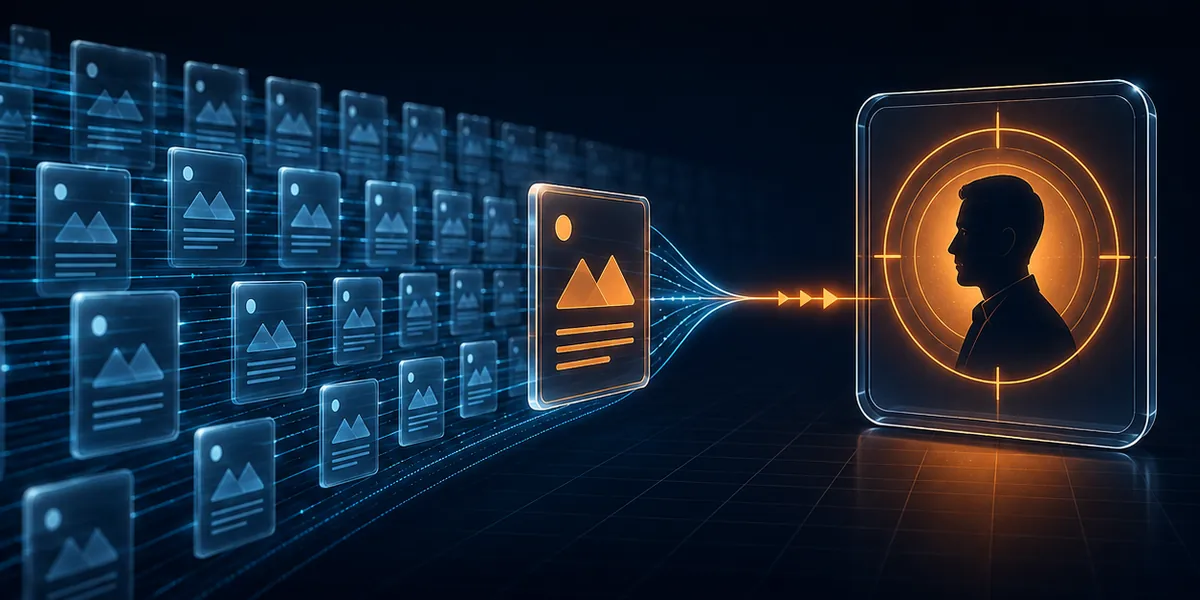

If you are getting more traffic but no sales to match, the natural reaction is to buy even more traffic. More budget on Google Ads, Meta Ads or SEO feels like the obvious lever. But when the returns stay disappointing, the problem is often not the number of people arriving. It is what happens to them next.
If your business has more traffic but no sales to show for it, the cause is usually the journey, not the volume. Check whether the advertisement and landing page tell the same story, whether the offer gives a reason to act, how easy it is to enquire, whether your tracking shows which channels bring qualified opportunities, and how quickly someone follows up.
Fix the weakest stage first, then scale the traffic.
Why more traffic but no sales is a journey problem
Think of a pipe with a crack in it. Pushing more water in does not fix the leak; it only means more water is lost. A customer journey works the same way. Every extra visitor travels the same path as the last one, so if that path leaks, a bigger budget simply sends more potential customers through the same break.
None of this is a criticism of paying for traffic. Advertising and SEO do what they promise: they bring people to your door. What happens after the click is a separate system, and it needs the same attention.
Increasing the budget only sends more potential customers through the same broken journey.
The customer journey, stage by stage
Every business has a customer journey, whether it was designed or not. Here are the six stages most businesses depend on, and what should be true at each one.
- Advertisement or search result It makes one clear, specific promise to the right person, not a vague claim to everyone.
- Landing page It continues the promise exactly. Someone who clicked an advertisement about one thing should land on a page about that thing, in the same words. Strong landing page conversion starts with this match.
- Offer It gives a compelling reason to act now: what the person gets, what happens next and why you are the right choice. Information alone is not an offer.
- Conversion The enquiry or purchase process is short, clear and works on a phone. Every extra field or unclear step costs you people who were ready to act.
- Tracking It reports more than clicks and form submissions. It shows which channels and campaigns produce qualified opportunities, so you can put money where it works.
- Follow-up Every lead gets a fast reply from a named person. A slow response wastes the work every earlier stage did.
Every stage should support the same commercial objective. If one stage pulls in a different direction, the whole journey weakens, even when the other five are strong.
Five signs your journey is leaking
You can often spot the broken stage from numbers you already have. Use this as a starting point:
| What you see | The likely cause | Where to look first |
|---|---|---|
| Plenty of clicks, few enquiries | The landing page does not continue the advertisement’s promise | Put the advertisement and the page side by side |
| Visitors read the page but do not act | The offer gives no compelling reason to act | Read it as a stranger: what do I get, and why now? |
| People start the form but do not finish | The enquiry process has too much friction | Count the fields and test the form on a phone |
| Enquiries arrive but you cannot tell which channel brings buyers | Tracking stops at clicks and form submissions | Check whether qualified leads and sales are tied back to each source |
| Good leads go cold | Follow-up is too slow or has no clear owner | Time how long a real enquiry takes to get a reply |
These are patterns, not diagnoses. Treat each one as a pointer to the stage that deserves a closer look, then confirm it with a proper test.
A one-hour journey check you can do this week
You do not need special tools to walk the path as your customer would. Set aside an hour and do this:
- Search for your service, or find your own advertisement, and click through as a stranger would.
- Read the landing page. Does it match what you clicked, and does it give a clear reason to act?
- Submit an enquiry (tell your team first). Note how long it takes and how many steps are involved.
- Check what your reports recorded. Did they count the enquiry once, with its source?
- Time the follow-up. How long before a real person replied, and did they know where you came from?
Write down the first point where you would have given up. That is where to start. If the trail goes cold at the last step, read why paid leads get lost after the form.
What to settle before you raise the budget
- Which stage of the journey is weakest right now, and how do we know?
- Does the landing page repeat the promise made in the advertisement?
- Is the offer clear enough that a stranger knows why to act today?
- Can a visitor enquire in a minute or two, on a phone?
- Do our reports show qualified leads and sales by channel, not only clicks?
- Does every enquiry get a reply from a named person within a time we can meet?
If any answer is “no” or “I do not know”, fixing that stage is likely to be worth more than the next increase in spend.
How I approach it at B-Digital Mark
I am an independent digital marketing specialist, and I work directly with my clients, with no agency layers between you and the person doing the work.
I connect paid advertising, SEO, conversion-focused websites, analytics and automation into one measurable growth system, with direct senior-level execution, because each of them performs only as well as the stage next to it. You can see how it fits together in the services overview.
If your business is receiving traffic but not generating enough qualified leads or sales, the problem may already be visible inside the journey. If you would like a second pair of eyes on it, message me directly.
Common questions
Why do I have more traffic but no sales?
Usually because something between the click and the purchase or enquiry is weak: the landing page does not match the advertisement, the offer is unclear, the form creates friction, or leads are not followed up fast enough. Walk the journey as a customer to find the first point where you would give up.
Should I increase my ad budget if my sales are low?
Not before you know which stage of the journey is failing. A higher budget sends more people through the same path, so it magnifies whatever is wrong with it. Fix the weakest stage first, confirm the improvement in your reports, then scale.
How do I know which stage of my customer journey is failing?
Look at where people drop off. Many clicks but few enquiries points to the advertisement or landing page. Many starts but few completions points to the form. Plenty of enquiries but few sales points to qualification or follow-up. Reports that cannot show this are a tracking problem in themselves.
What is a good conversion rate for a landing page?
There is no single number that applies to every business. It depends on your offer, price, market and traffic source. Compare your own results over time, change one thing at a time, and judge success by qualified leads and sales rather than by clicks alone.
Does SEO still help if my website does not convert?
SEO brings visitors, but it cannot make them act. If the website does not convert, you are paying for attention you cannot use. Improving landing page conversion first makes every future visitor, from SEO or advertising, more valuable.