Knowing how to choose a digital marketing agency matters more than finding the one with the best pitch. Most bad hires are not caused by bad agencies. They happen because the business never defined what it needed, compared proposals that were not comparable, and signed terms it did not read closely. This guide gives you a simple process and a scorecard you can use with every provider you speak to.
Start by writing down the one business result you need and your realistic budget. Build a shortlist of three to five providers who have done similar work. Send each the same brief, compare their proposals with the same scorecard, speak to the people who would actually do the work, and check the contract terms before signing.
The best choice is the provider whose plan fits your goal and whose people, proof, measurement and terms you trust, not the cheapest quote or the most polished presentation.
How to choose a digital marketing agency in eight steps
The process below works whether you are hiring your first provider or replacing one that did not work out. Steps 1 to 3 happen before you speak to anyone, steps 4 to 6 are the comparison, and steps 7 and 8 protect you once you have chosen.
Step 1: Define what you need before you contact anyone
Agencies are very good at selling what they do. If you arrive without a clear goal, you will be sold a channel instead of a result. Before you speak to anyone, write down:
- The business result. For example: more qualified enquiries for one service, more online sales, entering a new market, or a website that converts.
- Where things stand today. Current traffic, enquiries or sales if you know them, and what has already been tried.
- Your budget, split into the provider’s fee and the media budget for ads. Mixing these two is one of the most common sources of confusion.
- Your timeline and your own capacity. How much time can you or your team give to approvals, content and feedback?
- Constraints. Markets, languages, regulated claims, existing contracts or systems that must stay.
One page is enough. This page becomes the brief you send to every provider, so you can compare their answers fairly.
Step 2: Decide what kind of help you need
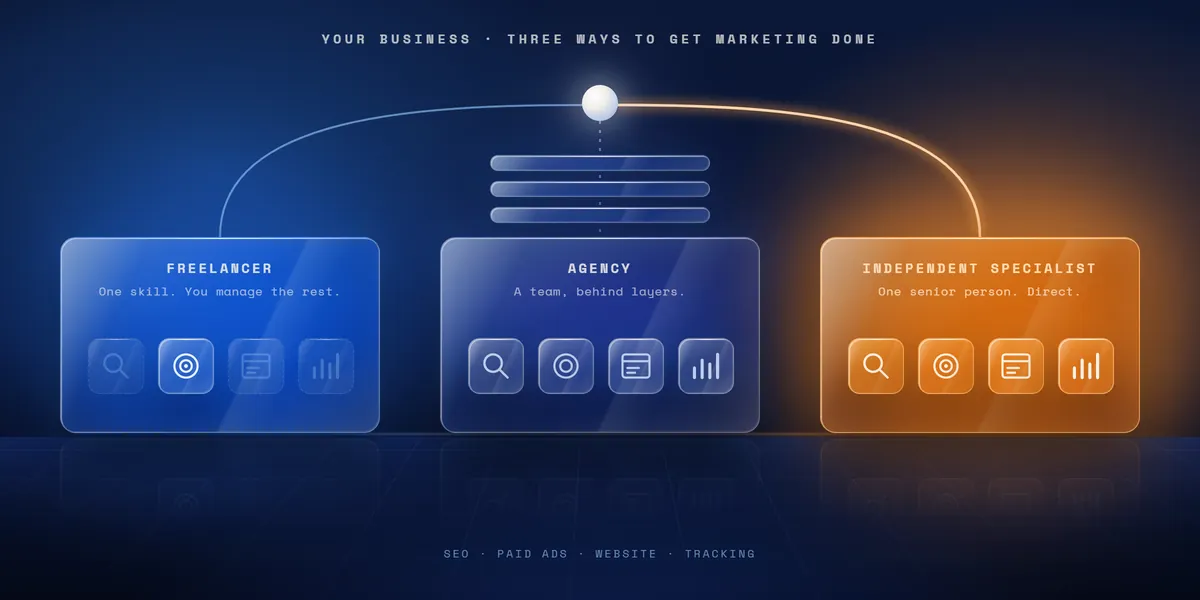
A full-service agency is only one option. Depending on your goal, a specialist agency, a freelancer or an independent specialist may suit you better. I compare the three in freelancer vs digital marketing agency. The short version:
- If you need many channels running at scale, look at agencies with a team for each.
- If you need one well-defined task, a freelancer may be enough.
- If you need senior strategy and hands-on work across a few connected channels, an independent specialist is worth considering.
For a digital marketing agency for small business needs, the most important question is often not size but seniority: who will actually think about your account each week?
Step 3: Build a shortlist of three to five
More than five proposals is hard to compare properly. Fewer than three gives you nothing to compare against. Good ways to find candidates:
- Recommendations from businesses similar to yours.
- Providers whose own visibility you can check: do they rank, publish useful material, and present themselves clearly?
- Case studies in your industry or with a similar type of customer, even if the details are anonymised.
Remove anyone who guarantees rankings, a fixed number of leads or a specific return before they have seen your data. Nobody controls search engines, ad auctions or buyers.
Step 4: Send the same brief and compare like with like
Send each provider your one-page brief and ask for a proposal that covers:
- What they would do in the first 30, 60 and 90 days, and why in that order.
- Who would work on your account, with their role and experience.
- How success will be measured and reported.
- The fee, what is included, and what would cost extra.
- Minimum term, notice period and ownership of accounts and work.
When every proposal answers the same questions, the differences become visible. A provider who ignores your brief and sends a standard package is telling you something.
Step 5: Score every proposal the same way
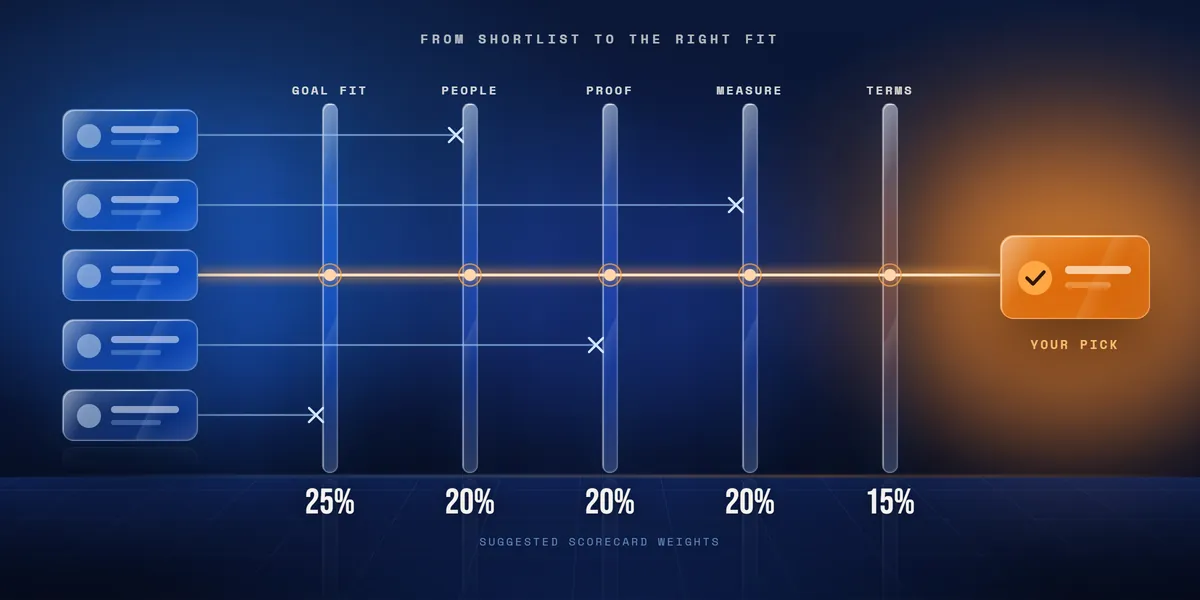
Use a simple scorecard. The weights below are a suggested starting point. Adjust them to your situation, but decide them before you read the proposals, not after.
| Criterion | What to look for | Suggested weight |
|---|---|---|
| Fit with your goal | The plan addresses your business result, not just a list of services | 25% |
| People | You know who does the work, and they have relevant experience | 20% |
| Proof | Relevant examples, with honest context about what they achieved and how | 20% |
| Measurement | Success is tied to enquiries, sales or cost per customer, not only clicks | 20% |
| Terms and ownership | Fair minimum term, clear notice period, accounts in your name | 15% |
Score each criterion from 1 to 5, multiply by the weight, and add up. The total will rarely make the decision for you, but it stops the most charming presentation from winning by default.
Step 6: Talk to the people who will do the work
The pitch meeting is often run by senior staff or a sales team. Ask to speak to the person who would manage your account day to day and the people who would build the campaigns, pages or content. In that conversation, listen for:
- Questions about your customers, margins and sales process, not just your marketing.
- Honest answers about what is uncertain.
- A clear explanation of how they would decide what to change when results stall.
These are the most useful questions to ask a digital marketing agency at this stage:
- Who exactly will work on my account, and how many other accounts do they handle?
- What would you need from me each week or month?
- What would you do first, and what would you deliberately not do yet?
- How will you report results, and how often will we review them together?
- Which accounts, tools and data will be in my name?
- What happens to the work, accounts and data if we stop working together?
- Can you show me a real report, with confidential details removed?
For red flags that apply to any provider, see the list in my freelancer vs agency guide.
Step 7: Check the contract before you sign
Most painful agency relationships become painful because of terms nobody read closely. Check:
- Minimum term. A long lock-in before the provider has shown how they work is a risk you carry alone.
- Notice period. How quickly can you leave if things are not working?
- Ownership. Ad accounts, analytics, domain, website, content and creative should belong to you.
- Scope. What exactly is included each month, and how are extra requests priced?
- Ad spend. Is your media budget paid directly to the platform from your account, or through the provider? Is there a percentage fee on top?
- Reporting. What is reported, how often, and in what format?
Step 8: Agree what the first 90 days should prove
A good start is not a promise of results. It is an agreement on what will be done and what you will learn. Agree:
- Which tracking will be checked or fixed first, so results can be measured. I explain why this matters in why clicks are not revenue.
- Which campaigns, pages or fixes will launch, and when.
- Which numbers you will review together at 30, 60 and 90 days.
- What would make you both decide to change course.
How I work at B-Digital Mark
B-Digital Mark is not a traditional agency. I am an independent digital marketing specialist and I work directly with clients, across SEO, Google Ads and paid social, websites and landing pages, tracking, and visibility in AI search. The person you speak to is the person doing the work, and accounts and data stay in your name.
If you are comparing providers, I am happy to be measured against the same scorecard, and to tell you honestly if a larger team would suit you better. You can see the services I provide and how I work.
Message me directly with your goal and your current situation, and I will tell you what I would do first.
Common questions
How do I choose the right digital marketing agency?
Define the business result you need and your budget, shortlist three to five providers with relevant experience, send them all the same brief, score their proposals with the same criteria, speak to the people who would do the work, and check the contract terms before signing.
What questions should I ask a digital marketing agency?
Ask who will work on your account, what they would do first and why, how they will measure success, which accounts will be in your name, what the minimum term and notice period are, and what happens to your data and work if you stop working together.
How do I choose a digital marketing agency for a small business?
Focus on seniority and fit rather than size. A small business usually needs a few channels working well together, so check who will actually think about your account each week, and whether the plan is tied to enquiries or sales rather than traffic alone.
How many agencies should I compare?
Three to five is usually enough. Fewer gives you little to compare against, and more makes it hard to evaluate each proposal properly.
Should I choose the cheapest agency?
Not by default. Compare what each fee includes, who does the work, how results are measured and what the terms are. A cheaper provider can cost more if your ad budget is wasted or you have to start again later.