A sales funnel for a service business looks different from an online shop’s. Nobody adds a consultation to a cart. People find you, check whether you are credible, make contact, talk to you, and then decide. Each of those steps can lose a good prospect. This guide shows the stages that matter for service businesses, what each one needs, and how to find the stage that is costing you the most clients.
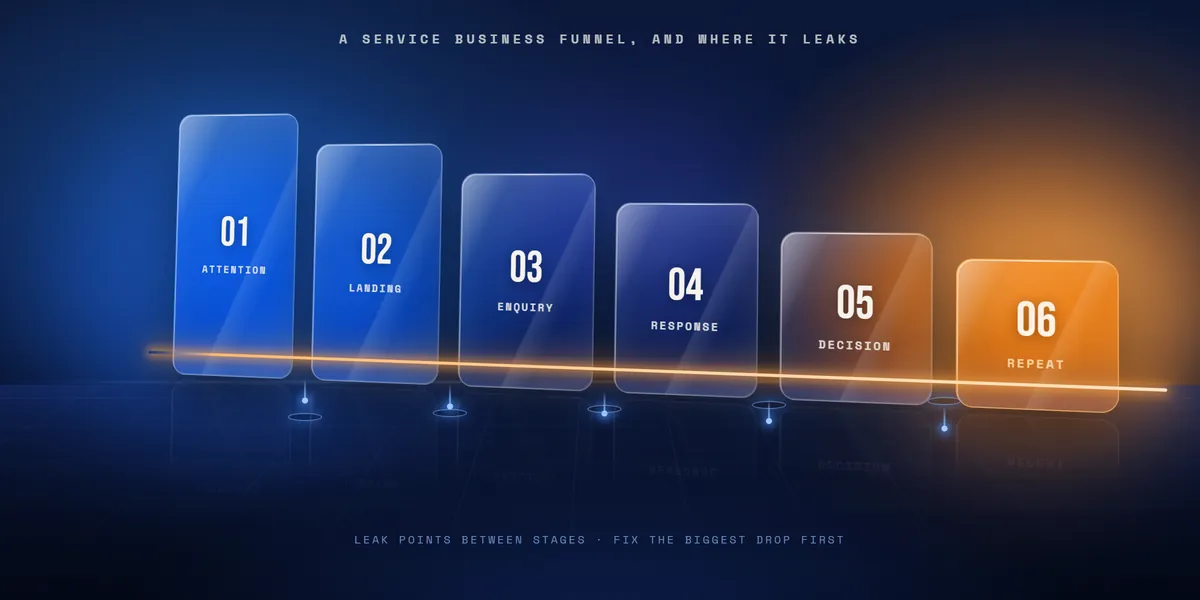
A sales funnel for a service business usually has six stages: attention, a landing page that answers the visitor’s question, an easy enquiry, a fast and personal response, a clear decision step such as a call or proposal, and follow-up that turns clients into repeat clients and referrals.
Most service businesses do not need more traffic first. They need to find the stage where good prospects drop out, fix that, and only then spend more to bring people in.
What is a sales funnel?
A sales funnel is the path a person takes from first hearing about you to becoming a paying client. It is called a funnel because fewer people continue at each step: many see an ad or a search result, fewer visit, fewer enquire, and fewer still become clients.
The idea is useful only if you treat it as a series of measurable steps. When you know how many people reach each stage, you can see where the biggest drop happens and fix that stage first, instead of guessing.
Why a service business funnel is different
Online shops sell with a product page and a checkout. A service business sells through trust and conversation. That changes what the funnel needs:
- The conversion is an enquiry, not a purchase. A call, a WhatsApp message, a form or a booking.
- A person is part of the funnel. How fast and how well someone replies is as important as the ad or the page.
- The decision takes time. Prospects compare providers, ask questions and need reassurance.
- Repeat work and referrals matter. A satisfied client is often the cheapest source of the next one.
The six stages of a sales funnel for a service business
- Attention. People who need your service find you through search, ads, maps, social media or referrals. The goal is to reach people with a real need, not just anyone.
- Landing page. The page they arrive on answers their question quickly: what you do, who it is for, why you are credible and what to do next. Sending paid traffic to a general homepage often loses people here, as I explain in your homepage is not a landing page.
- Enquiry. Contacting you is easy and obvious: a visible WhatsApp or call button, a short form, or a booking link. Every extra field or step loses some people.
- Response. Someone replies quickly, personally and usefully. Slow replies are one of the most common and least visible leaks. See automate the reply, not the selling.
- Decision. A clear next step, such as a short call, a site visit or a written proposal, with follow-up when the prospect goes quiet.
- Repeat and referral. After the work, you stay in touch, ask for reviews and referrals, and offer the next relevant service. I cover this in stop paying twice for the same customer.
Where service funnels usually leak
These are the leaks I see most often. Each one wastes money spent on the stages above it.
| Stage | Common leak | What to check |
|---|---|---|
| Attention | Traffic from people who will never buy | Search terms, ad targeting, locations, languages |
| Landing page | Visitors cannot tell quickly if you fit their need | One clear message, proof, visible contact option, mobile speed |
| Enquiry | Contact is hard or hidden | Number of steps, form length, working WhatsApp and phone links |
| Response | Enquiries wait hours or days for a reply | Who replies, how fast, outside working hours |
| Decision | Prospects go quiet and nobody follows up | A follow-up routine and a record of every open enquiry |
| Repeat | Past clients are forgotten | Regular contact, review requests, referral asks |
Two leaks deserve special attention because they are invisible in most marketing reports. Enquiries that arrive but are never properly handled, which I describe in you paid for the lead, then lost it, and leads nobody records an outcome for, covered in unanswered or unsuitable?.
How to build your lead generation funnel step by step
- Pick one service and one audience. A funnel for “everything we do, for everyone” is hard to make convincing. Start with the service that is most profitable or most in demand, and the type of client who buys it.
- Write down the questions buyers ask. Before they contact you, prospects want to know what you do, whether you have done it for people like them, roughly what it involves, how long it takes and what happens next. Your landing page should answer these plainly.
- Build one focused landing page. One page, one service, one main action. Include proof you can genuinely show, such as examples, reviews or a short explanation of your process. Make the contact option visible on a phone without scrolling far.
- Make contact easy and trackable. Offer the contact method your clients prefer. For many service businesses that is WhatsApp or a phone call, not a long form. Track every contact click and form submission, so you can see which pages and campaigns produce enquiries.
- Set a response routine. Decide who answers new enquiries, how fast, and what the first reply includes. A short automated acknowledgement can help outside working hours, but the real reply should come from a person.
- Track every enquiry to an outcome. Keep a simple record: date, source, service, status and outcome. Even a spreadsheet works. Without it, you cannot tell whether the problem is the ads, the page, the response or the sale. Cheap leads can still be expensive if few of them become clients, as I explain in cheap leads can cost more.
- Bring people in, then improve the weakest stage. Only once the stages above are working is it worth increasing traffic through search or ads. Then review the numbers regularly and fix the stage with the biggest drop.
How to measure your funnel
You do not need complex software to start. Track these numbers each month:
- Visitors to the landing page, by source.
- Contact clicks and form submissions (enquiries).
- Enquiries replied to, and how quickly.
- Calls, meetings or proposals that followed.
- New clients won, and their value.
- Repeat clients and referrals.
Divide each number by the one before it to see where the biggest drop is. That is the stage to work on next.
How I build funnels at B-Digital Mark
B-Digital Mark is not a traditional agency. I am an independent digital marketing specialist, and I build funnels as one connected system: the search and ad campaigns that bring people in, the landing page that answers their question, contact options and tracking that show which enquiries came from where, and a clear view of what happens after the enquiry.
Because one person sees the whole chain, I can tell you whether the problem is traffic, the page, the response or the follow-up, and fix the stage that actually matters. You can see the services I provide and how I work.
If your marketing brings visitors but not enough clients, message me directly with what you sell and how people contact you today, and I will tell you where I would look first.
Common questions
What is a sales funnel for a service business?
It is the path a prospect takes from first finding you to becoming a client: attention, a landing page, an enquiry, your response, a decision step such as a call or proposal, and follow-up that leads to repeat work and referrals.
What is a sales funnel in digital marketing?
In digital marketing, a sales funnel is the series of online and offline steps from an ad, search result or social post to a sale. Each step is measured, so you can see where people drop out and improve that step.
Do I need special funnel software?
Not to start. A focused landing page, working contact options, tracking for enquiries and a simple record of every lead’s outcome are enough to see where your funnel leaks. Tools can help later, once the process is clear.
Should I fix my website or run more ads first?
Usually the website and the follow-up first. More traffic into a funnel that leaks at the landing page or the response stage mostly increases the cost of each new client.
How long does it take to build a funnel for a service business?
A first version, with one landing page, contact tracking and a response routine, can often be set up in weeks rather than months. Improving it is ongoing, based on what the numbers show each month.