How much does a website cost for a small business? The honest answer is a range, from a few hundred dollars a year for a do-it-yourself builder to well over ten thousand for an agency build. The number on the quote matters less than what you are buying: a page that exists, or a page that brings in enquiries. This guide explains the typical ranges, the costs that arrive after launch, and how to choose without paying twice.
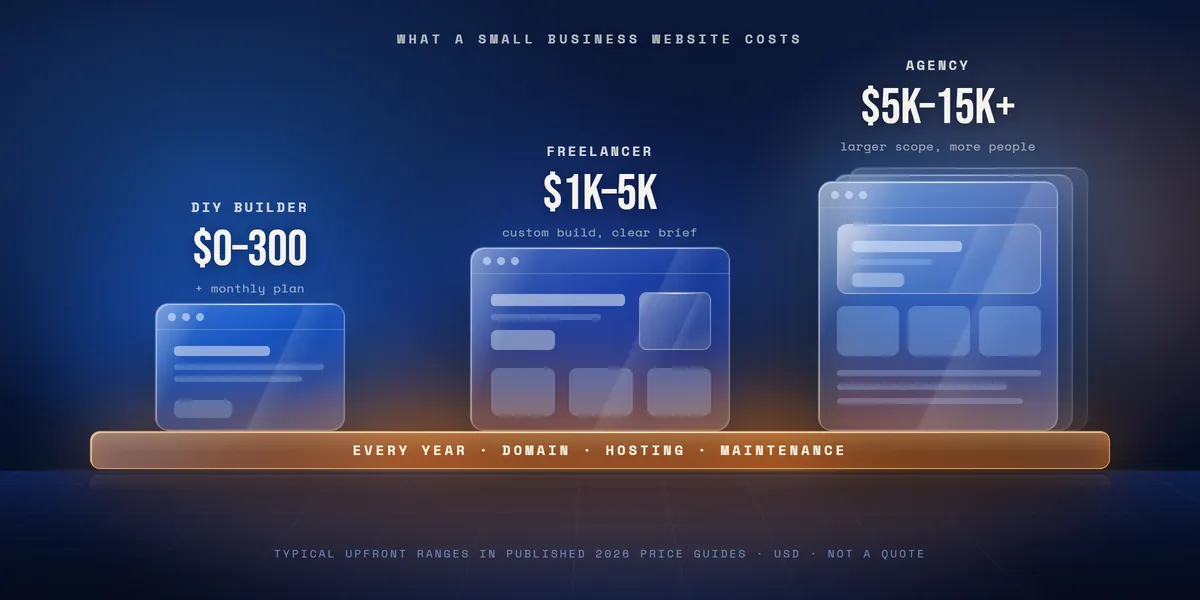
Published 2026 price guides put a DIY website builder at roughly $0 to $300 upfront plus a monthly plan, a freelancer-built small business site at roughly $1,000 to $5,000, and an agency-built site at roughly $5,000 to $15,000, with complex or custom projects going higher. On top of that, budget yearly for the domain, hosting, security and updates.
The right budget depends on what the website has to do. A site that only needs to look credible can be cheap. A site that must rank in search, carry paid traffic and turn visitors into enquiries needs more planning, and that is where most of the price difference comes from.
These figures are typical ranges from public 2026 price guides, mostly in US dollars, such as WebsiteSetup’s small business website cost guide. They are a starting point for budgeting, not a quote. Local rates, languages and scope change them a lot.
How much does a website cost for a small business: three routes
| Route | Typical upfront cost | Ongoing cost | Best for | Main risk |
|---|---|---|---|---|
| DIY website builder | About $0 to $300 | A monthly plan, roughly $15 to $50 for most small business tiers | Getting online quickly with a simple site | Your own time, generic structure, limited SEO and tracking |
| Freelancer | About $1,000 to $5,000 | Hosting plus maintenance if they look after it | A custom site with a clear brief | Quality varies; strategy and copy often left to you |
| Agency | About $5,000 to $15,000 and up | Hosting plus a maintenance or retainer plan | Larger sites, many stakeholders, complex features | Higher cost, layers, slower changes |
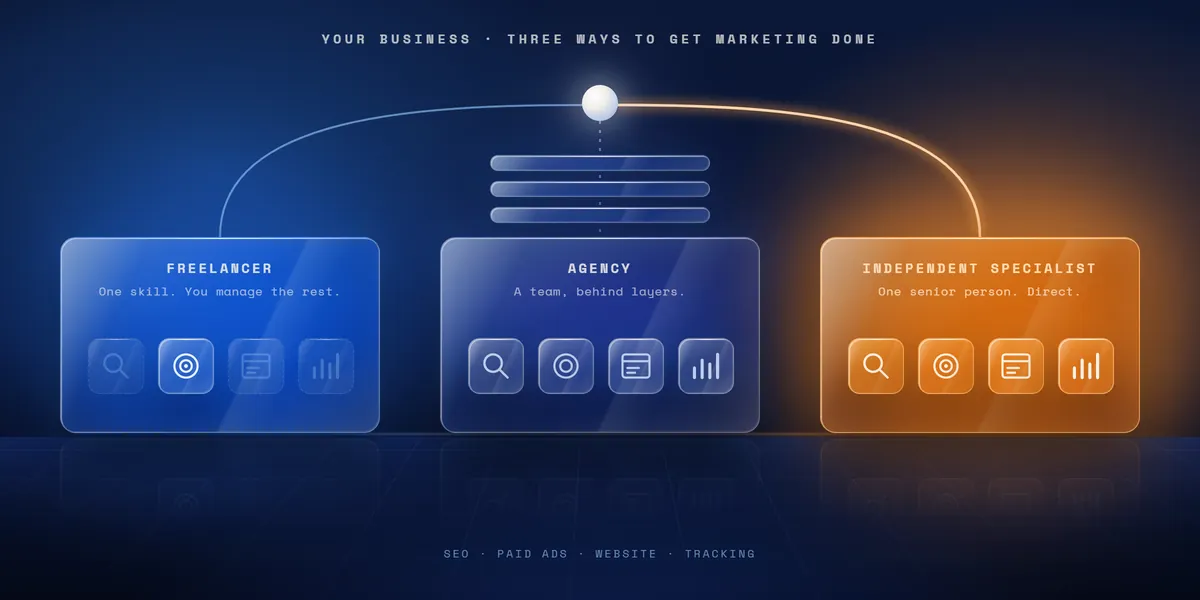
There is also the option I described in freelancer vs digital marketing agency: an independent specialist who plans the site around search, ads and tracking from the start. Pricing in that model usually sits between a freelancer and an agency and depends entirely on scope.
What actually drives the price
Two websites can look similar and cost very different amounts. The difference is usually in these factors:
- Number of pages and templates. A five-page site and a forty-page site with service, location and blog templates are different projects.
- Copywriting. Writing clear, persuasive pages takes real time. Many cheap quotes assume you will supply all the text.
- Custom design vs a theme. A well-chosen theme adjusted to your brand is cheaper than a design built from scratch. Both can work.
- Features. Booking, online payments, a shop, member areas, multiple languages or integrations with a CRM all add cost.
- SEO foundations. Page structure, technical setup, speed, schema and a plan for which searches each page targets.
- Tracking. Setting up analytics and conversion tracking so you can see which pages and campaigns produce enquiries.
- Languages. A bilingual or trilingual site is not a translation job. Each language needs its own pages, search terms and checks.
If one quote is far cheaper than another, compare these items line by line. The gap is usually explained by something that is missing.
The yearly costs most quotes leave out
The build is only the first bill. Small business website cost continues every year:
| Item | What it covers | Typical range |
|---|---|---|
| Domain | Your web address, renewed yearly | Roughly $10 to $25 a year for a standard .com |
| Hosting | The server your site runs on | From a few dollars a month for basic hosting to much more for managed or high-traffic plans |
| Builder plan | Hosting, security and templates if you use a builder | Paid monthly or yearly |
| Premium plugins or themes | Licences for paid features on WordPress | Varies by what you use |
| Maintenance | Updates, backups, security, fixes | From a few hundred to a few thousand a year, depending on who does it and how much |
| Content and changes | New pages, updates, new offers | Your time or a provider’s time |
Website maintenance cost is the item most businesses underestimate. An unmaintained site slowly breaks: plugins go out of date, forms stop sending, pages load slowly and security risks grow. Plan for it from the first day instead of discovering it after something fails.
Cheap vs expensive: which costs more in the end?
A cheap website is a good choice when the site only needs to confirm you exist: a name, a clear description, contact details and proof that you are real. Many buyers check exactly that before they reply, as I explain in buyers check your digital presence before they reply.
A cheap website becomes expensive when it is expected to do a job it was never built for:
- You run paid ads to it and the visitors leave, because the page does not answer their question.
- It does not appear in search, because nobody planned which searches each page should target.
- You cannot tell which campaigns bring enquiries, because tracking was never set up.
- You rebuild it within a year or two, and pay for the website twice.
The useful question is not “what is the cheapest website?” but “what does this website need to do, and what is that worth to the business?”
How to set a realistic budget
- Define the job. Is the site for credibility, for search traffic, for paid campaigns, for bookings or for sales? Write it down in one sentence.
- List the pages that job needs. For a service business that is usually a homepage, one page per main service, an about page, proof such as results or case studies, and contact.
- Decide who writes the content. If it is you, budget your time honestly. If it is the provider, make sure it is in the quote.
- Add the yearly costs. Domain, hosting, maintenance and any paid plugins or plan.
- Compare quotes against the same scope. Ask each provider to price the same page list and features, so you compare like with like.
Questions to ask before you pay for a website
- Will the domain, hosting and website be registered in my name?
- Who writes the page content, and how many revisions are included?
- Which search terms is each main page planned to target?
- Will analytics and enquiry tracking be set up and tested?
- How fast will the site load on a phone, and how will you check it?
- What happens after launch: who updates, backs up and secures the site, and at what cost?
- Can I edit simple text and images myself?
- What is not included in this price?
Website vs landing page: do you need both?
Not always. If you plan to run paid ads to one offer, a focused landing page is often a better first investment than a full website redesign. If you need trust, search visibility and several services explained, you need a proper website. Many businesses end up needing both. I explain the difference in landing page vs homepage for paid ads, and why a clear website wins the buyer’s shortlist in clarity wins the shortlist.
How I approach websites at B-Digital Mark
B-Digital Mark is not a traditional agency. I am an independent digital marketing specialist, and I plan websites around the job they need to do for the business: being found in search and AI answers, carrying paid traffic, and turning visitors into enquiries you can track.
That means the structure, page content, SEO foundations, speed and conversion tracking are planned together, by the same person who will later run the search or ad campaigns. You work with me directly, the accounts stay in your name, and I tell you plainly when a simpler, cheaper option is enough. You can see the services I provide and how I work.
If you are pricing a new website or wondering whether your current one is worth fixing, message me directly with what your business does and what you want the site to achieve. I will tell you honestly what it needs.
Common questions
How much does a website cost for a small business?
Published 2026 price guides put a DIY builder at roughly $0 to $300 upfront plus a monthly plan, a freelancer-built site at roughly $1,000 to $5,000 and an agency-built site at roughly $5,000 to $15,000 or more. Add yearly costs for the domain, hosting and maintenance. The scope of the site matters more than the route.
How much does a small business website cost per month?
With a website builder you usually pay a monthly plan. With a custom site you pay for hosting, plus maintenance if someone looks after it for you. The total depends on the plan, the hosting and how much support you need, from a small monthly amount for a simple site to considerably more for managed hosting and regular updates.
What is a typical website maintenance cost?
Price guides range from a few hundred to a few thousand dollars a year, depending on whether you do updates yourself or pay someone for updates, backups, security and fixes. A domain renewal alone is usually around $10 to $25 a year for a standard .com.
Is a cheap website good enough for a small business?
It can be, if the site only needs to show that your business is real and how to contact you. If you want it to rank in search, carry paid ads or generate enquiries, a cheap site that was not planned for that job often ends up costing more through lost leads and a rebuild.
Should I build my website myself?
A builder is a reasonable start if your budget is very small and you have time. Be honest about the hours involved, and make sure you can still add proper page titles, descriptions, tracking and a clear call to action. Those are the parts that most affect whether the site brings business.