
A founder, a procurement manager or a commercial team is comparing potential suppliers. They have several tabs open and not much time. They are not going to interpret phrases like “innovative solutions” or “end-to-end excellence”. They are looking for the supplier whose B2B website makes the decision easiest, and the rest quietly drop off the shortlist.
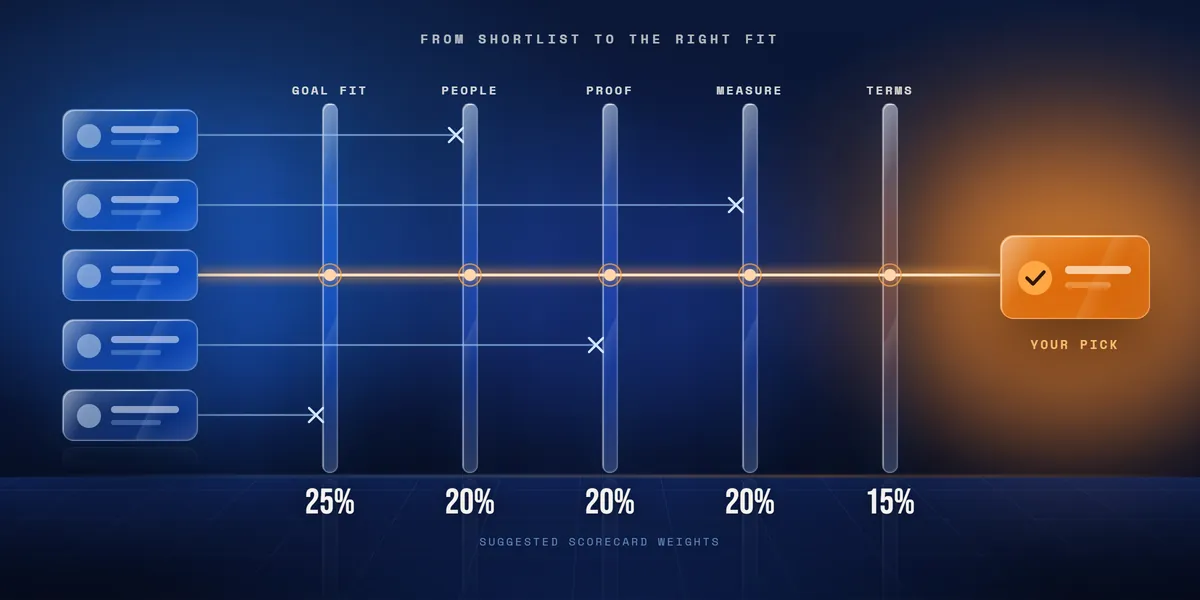
A polished B2B website can still lose the shortlist if buyers cannot quickly see what you deliver, who you serve, what problem each service solves, why to trust you and what to do next. When those answers are scattered or vague, the buyer cannot recommend you confidently inside their own company.
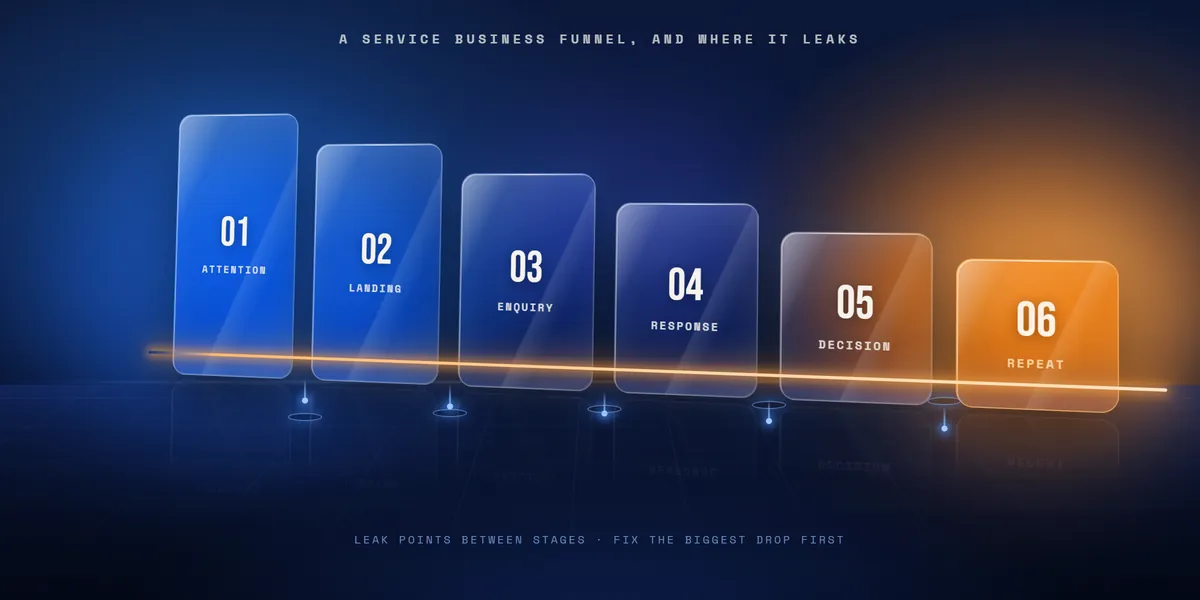
A strong website moves buyers through a sequence: relevance, understanding, confidence, action. SEO and advertising bring visitors to that sequence, but they cannot fix positioning that still needs a sales call to explain.
How buyers shortlist suppliers
In B2B buying, the person visiting your website is rarely the only decision-maker. They are gathering evidence to take to colleagues, a manager or a procurement team. To do that, they need to be able to explain your company in a sentence or two and forward a page that makes the case.
That changes what your website has to do. It is not only persuading a visitor. It is equipping a person to persuade others when you are not in the room. If your team explains the company better during meetings than your website does before them, the website is delaying the buying decision.
This is a conversion problem that happens before the visitor ever reaches your contact form. Many never get that far, because they cannot tell whether you are relevant.
Five questions your B2B website must answer quickly
Almost every shortlist decision rests on the same five questions. This table shows what a vague answer looks like beside a clear one. The examples are illustrations of wording, not claims about any business.
| The buyer asks | A vague answer | A clear answer |
|---|---|---|
| What exactly do you deliver? | “End-to-end digital excellence” | “Google Ads, SEO and website conversion for B2B companies” |
| Which businesses and markets do you serve? | “Clients across many industries” | “Service and manufacturing companies selling into the Gulf” |
| What problem does each service solve? | “Innovative solutions for growth” | “More qualified enquiries from the same ad budget” |
| Why should we trust your capability? | “A passionate, experienced team” | Specific results, named methods and real examples |
| What should we do next? | Five competing buttons | One clear next step suited to where the buyer is |
If a buyer has to hunt for any of these, they will either leave or guess. Neither helps you.
Relevance, understanding, confidence, action
A B2B website works best as a sequence. Each step earns the next, and a gap at any point is where buyers leave.
- Relevance Within seconds, the buyer can tell that you serve a company like theirs and handle a problem like theirs. The first screen says who you help and with what.
- Understanding Each service has its own page that explains what it is, what is included and what problem it solves, in plain language and not in jargon.
- Market context The page shows you understand the buyer’s market: the regions, regulations, buying habits and language they work in.
- Confidence Credible evidence supports the claims: real results, specific examples, named methods and honest limits. Where proof is not available yet, say less rather than invent more.
- Action The buyer is offered a next step that suits their stage, and it is easy to take.
Messaging has to carry all five. Website messaging that stays at the level of slogans can only deliver the first.
A service page structure that makes the decision easier
Many B2B sites describe all their services in one block on the homepage. A buyer researching one specific service then has nowhere specific to land. A clear service page structure helps both people and search engines understand what each page is for.
A useful service page usually answers, in order:
- What it is, in one plain sentence.
- Who it is for, including the type of company and market.
- What problem it solves, and why that problem is costly.
- What is included, so the buyer knows what they would receive.
- How it works, as a short, honest process.
- Proof, such as results, examples or explanations of method.
- Common questions, especially the objections buyers raise in calls.
- One clear next step.
One service per page also gives each page a single subject, which makes it easier to find in search and easier to forward to a colleague.
Calls to action that fit the buyer’s stage
A single “Contact us” button asks every visitor for the same commitment, whether they have known you for a day or a year. Buyers at different stages need different next steps.
| Buyer stage | What they want | A fitting next step |
|---|---|---|
| Just learning | To understand the problem | A guide, checklist or article that helps them think it through |
| Comparing suppliers | To see how you work | A clear service page, a description of your process, relevant examples |
| Ready to talk | To check fit and next steps | A direct way to message or book a conversation |
| Needs internal sign-off | Something to share | A concise page or summary that explains the offer |
Offering the right next step at the right moment means fewer buyers are asked for more than they are ready to give.
Why SEO and advertising cannot fix unclear positioning
Search and paid media can bring more visitors to your site. They cannot make those visitors understand you. If the positioning still requires a sales call to explain, more traffic simply produces more people who leave confused. I look at the same pattern in why more traffic will not fix a broken customer journey.
Clarity also changes how well your traffic converts. A visitor arriving from an advertisement should land on a page that repeats the promise and offers one action, as I explain in why a homepage is not a landing page. Strong positioning makes every other channel work harder, because each one points to something a buyer can understand.
A ten-minute shortlist test
You can find out how clear your website is without any specialist tools. Do this with someone who does not know your business well.
- Show them your homepage for five seconds, then hide it. Ask them what the company does and who it is for.
- Ask them to find one specific service and explain, in their own words, what it solves.
- Ask them where they would look for proof, and whether they believe what they find.
- Ask them what they would do next, and whether that step is obvious.
- Ask whether they could forward one page to a colleague and have it make sense without you.
If any answer is hesitant, you have found a place where buyers leave.
Questions to ask whoever manages your website
Whether your website is handled by an agency, a freelancer or an internal team, these questions show whether it is built for the buyer’s decision or for the company’s pride.
- In one sentence, what do we deliver, and who is it for?
- Does each service have its own page that explains the problem it solves?
- Where is our proof, and how specific is it?
- What are the next steps for visitors at different stages?
- Could a buyer recommend us internally using only our website?
- Which parts of our website do we explain better in meetings than online?
If the honest answer to the last question is “most of it”, your website is carrying a job your sales team is doing instead.
How I approach it at B-Digital Mark
I am an independent digital marketing specialist, and I work directly with my clients. There are no account-manager layers between you and the person doing the work.
I connect website strategy, service-page design, SEO, conversion journeys and analytics into one system, with transparent reporting. The aim is a website that makes your value easier to understand, so the right buyers can see the fit, trust it and take the next step. A site that is clear but not credible still loses ground, which is why I also look at what buyers check before they reply. You can see how this fits with the rest of my services.
If your team explains the company better during meetings than your website does before them, message me directly and we can look at what buyers see first.
Common questions
What makes a good B2B website?
A good B2B website helps a buyer see quickly what you deliver, who you serve, what problem each service solves, why to trust you and what to do next. It uses plain language, specific evidence and one clear next step suited to the buyer’s stage, so the buyer can confidently recommend you inside their own company.
How many pages should a B2B website have?
Enough to give each service and each important buyer question its own clear page, and no more. There is no ideal number. Prefer fewer, more useful pages over many thin ones, and make sure every page has a distinct purpose.
Should every service have its own page?
Usually, if the service has its own buyer, problem and objections. A dedicated page lets a buyer researching that service land somewhere specific, and gives search engines a clear subject for that page. Avoid creating near-identical pages that only vary a keyword.
How do I make my website messaging clearer?
Replace general claims with specific statements about what you deliver, for whom and what changes as a result. Use the words buyers use, put the most important answer first, and back claims with evidence you can stand behind. Then test it on someone who does not know your business.
Can SEO or ads fix a confusing website?
They can bring more visitors, but they cannot make the website easier to understand. If positioning still needs a sales call to explain, extra traffic mostly produces more confused visitors. Clarify the message first, then use SEO and advertising to send the right people to it.